Question: How many Database Server trace files does
it take for Oracle Support to change a light bulb?
Answer: We need 2 more Database Server trace files to tell you.
By 1996, Vicken, with a math degree from UC Berkeley, had already discovered and solved one of the biggest challanges to modern day AI. How to make computers take correct action on
immediate future, instead of climaxing on past data. In 1996, and again in 2005, he stated in an official investigation,
studied by the highest leaders of Oracle Database Support, then by Oracle's own patent attorney, Kim Kanzaki, who also held a Ph.D. in Computer Science,
that solving an Oracle database failure problem is like authoring
a story, not like solving a math problem. When you write a story, you focus on the next sentence not only on the past. When a Tesla is at an intersection, it's trying to figure out
what to do next, not climax on past data. So far, in 2026, it is failing and killing people.
By 1996, Vicken arrived at 4 historic observations, which, in 2026, every major university and high tech authority agrees with. Oracle suppressed the research needed to explore them and fired Vicken. They are:
1 - In AI based computing, data and context get de-coupled, resulting in the dumbest results. Between 1996 - 2006, Oracle managers and VP's laughed at Vicken for this observation, and fought him.
2 - Literature, it turns out, has mathematical significance. When Vicken started telling Oracle's engineers to start going over the technical stories of Oracle failures, their
success rate skyrocketed. In 2026, many universities, including Columbia, are co-teaching math classes with English in the same class.
3 - Once the context and the foundational literature components get de-coupled from science, it does not matter how many bugs you fix, you're going backwards. This partially explains
why Elon Musk promised Full Self Driving by the end of 2016, and in 2026, he failed even with xAI, when every founder left him. He's light years and galaxies away from FSD success.
4 - Vicken and the engineers he worked with, instinctively started making the correct diagnostic decisions about the immediate future. When Vicken asked for this fact to be researched,
Oracle fought him and fired him. In 2026, major univesities are trying to teach "Digital imagination". This discovery applies to many areas of AI. Tesla's failures are one example, out of many.
Vicken succeeded with real production data with 100% success, when every minute was worth millions, under tremendous pressure, not lab data. Oracle fought his success, and,
in 2026, is trying to figure it out, while paying off political leaders from Armenia to the USA.
Decades before
top universities started co-teaching math classes with English literature and humanities to solve AI-related shortcomings,
in 1996, and then again in 2005, as an Oracle Support Rep, during Oracle's official investigation into Vicken's discoveries,
Vicken wrote that to solve the severe database outage problems, Oracle Support
reps needed to think like an author, writing a story, not like a mathematician, solving a math problem. Vicken discovered hallucinations long before others did.
He discovered that the scientific, mathematician's approach with out-of-context data will produce failure with confidence. Oracle carefully studied Vicken's
data and success record. In 2007, Oracle made him the first candidate for a patent on Oracle's diagnostics and context. Vicken's success is
unmatched. Universities and high tech companies, including Oracle, lag him by 3 decades.
According to the link in the above paragraph, Columbia University is teaching digital imagination to students. By
1996, Vicken had figured out that bringing up and solving catastrophic database failures was like writing the next
sentence in a story, not like solving a math problem. The evidence is with Oracle, if Oracle did not destroy it.
Even though computers succeed in many episodes of detecting threats and taking action, they still suffer failures when it comes to taking action
pertaining to the immediate future. When a Tesla is at an intersection, it's trying
to figure out what to do next. Does it go left, right or straight? at what speed? Any miscalculation, and that Tesla will hit a
parked fire truck, with lights flashing. A Boeing FADEC software is also trying to decide how to help the pilot.
When it comes to dealing with the future, computers are used for analysis, such as predictive modeling, for example studying
health or crime related future trends, but when it comes to interfering with immediate human action, so far they have proven to be painfully
inadequate, even fatal. Science and technology that predict weather or tell us the path of a hurricane cannot tell a Tesla, in an intersection,
how to drive in the next sub-second, causing fatalities.
From 1996 to the present day, Vicken broke that barrier. When an Oracle system was down, and every minute of downtime was
worth millions of dollars, Vicken studied the existing diagnostics that came from several dozen if not several hundred sources,
processed that data that gave him thousands of possible suspects and remedial options
and introduced the immediate and future action to bring those systems up. His success record on 400 of the toughest cases: 100%.
Vicken discovered in 1996, that one of the reasons computers are horribly bad in taking immediate future action, is because past data
was getting de-coupled from context. Vicken figured out how to re-connect context with data, when millions of lines of diagnostic
output was derailing Oracle Developers and Support Reps. In 2007, Oracle made Vicken the first candidate for a patent, in the entire company's
history, on the role of context in diagnostics. As of 2025, the entire high tech industry does not have a solution to the context challenge,
including the most famous players like Jensen Huang, Ilya Sutskever and Elon Musk.
When an AI based image generator produces an image, or when Google succeeds to translate languages, it's processing previously
stored and labeled data. It lives in the past, not future. It looks like human intelligence, but it's misleading. Sorry Geoffrey Hinton
and Google, your transformer discovery will not drive a Tesla, and the reason why Waymo is partially succeeding is because it has
the entire driving area mapped with the greatest detail. It knows where every speed bump is, before the car gets there. It's an
impressive endorsement of Vicken's context discovery. Waymo cars are surrounded with street and infrastructure-map context data,
without which they will be worse than the worst driver in the world. Vicken proved at
Oracle that the relationship of an AI-expert to his challenge is like the relationship that an author has to a story, not like
the relationship that a mathematician has to a math problem.
On October 23, 2024, Elon Musk stated during the Tesla Quarterly Earnings Call, that he did not have the context challenge solved.
Why are his cars on streets? His Tesla cars consistently fail to decide what to do next in many situations.
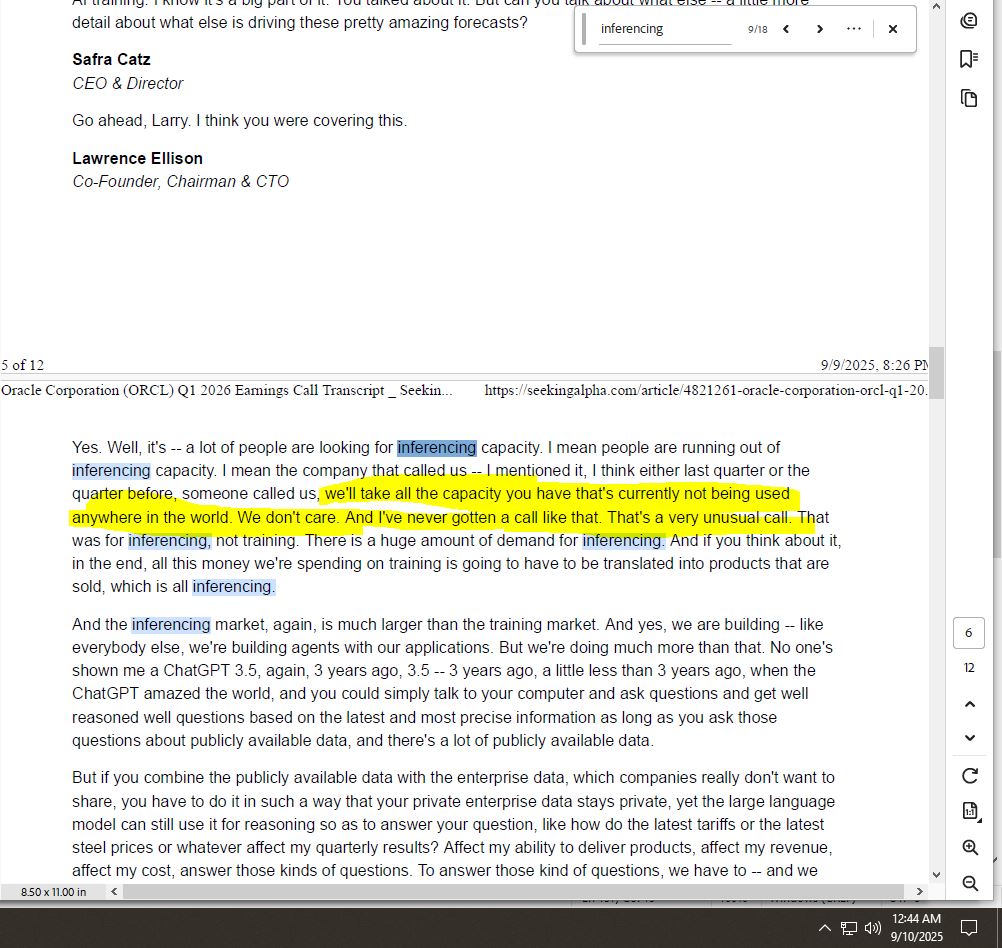
On September 9, 2025, during his opening statements for Oracle's Quarterly Earnings Call, Larry Ellison mentioned the word inferencing
8 times. Inferencing was mentioned during the concall 18 times. Inferencing is heavily used in self driving cars to decide what the car
will do next. Larry also mentioned
how much resource inferencing is using up from computing capacity. In the same conference call he mentioned a customer who told him
they will use as much leftover capacity that Oracle has to offer. What Vicken solved in 1996 and forward, is still a capacity exhausting
challenge for the industry, obviously.
Here is the evidence:
Link 1
Link 2
From President Biden's National Security Commission on Artificial Intelligence - Final Report, signed by Oracle's Safra Catz - 2021